The widest gap I’ve seen in my career isn’t between companies that have AI and companies that don’t. Everyone has it. The gap is between what these systems can already do and what enterprises are actually asking of them. It is enormous, it is nobody’s fault, and it closes faster than anyone in the room believes.
I keep watching the same scene. A large, serious, well-run company decides AI is important — correctly — and then prices the decision as a moonshot. Three-year roadmap. Platform migration first. Data lake before use case. A steering committee with a charter. By month nine there’s a programme with a name, a budget line, and no users, and someone senior starts using the word journey, which in my experience is what people say when nothing has shipped.
Meanwhile, two floors down, someone in operations has quietly wired a model into the claims intake queue and taken four days out of it.
The second thing is the actual shape of this. Not because the small thing is cute, but because the leap is genuinely smaller than the story we’ve built around it — and the payoff on the other side is genuinely larger. That combination almost never happens. It’s happening now, and it will not stay this cheap.
The third turn: information, knowledge, insight
Two things have already reorganised the enterprise in my working life, and both looked optional while they were happening.
The first was search. Information became findable — everything, everywhere, in a box. Inside companies it was messier than the web, but the direction was the same: files, ERPs, inboxes, archives, indexed.
The second was software proper. ERPs, CRMs, dashboards. Operations became knowledge. The business could finally tell you what it knew, as long as you knew where to look, opened the right report, and connected it to everything else yourself.
Both turns stopped at the same place. They organised. They did not do the work. You still had to find it, read it, interpret it, and act — and that last mile, the human mile, is where every enterprise’s time actually goes.
The third turn removes it. A system that reads across all of it, reasons over it, turns it into insight, and then acts on what it concluded — inside the standard operating procedures and workflows you already run, not bolted onto them as a separate tool. Not a better index. Not a better dashboard. The first technology in this sequence that closes the loop instead of handing you a report and wishing you luck.
Information became findable. Then it became knowledge. Now it becomes insight — and insight acts.
The job nobody ever wanted is over
Here’s the part I find genuinely thrilling, and I don’t use that word much.
For thirty years, most of the enterprise middle has been a translation layer. Intent into specs. Specs into tickets. Data into reports. Reports into decisions. Decisions into a deck for the meeting where the decision gets made again. We hired hundreds of thousands of bright, expensively educated people and put them to work as converters — moving a fact from one format to another so the next person could move it again.
We called this knowledge work. It was assembly work with a laptop. White-collar workers have been the blue-collar workers of the knowledge industry for a generation. Everybody knew it. Nobody said it out loud, because there was no alternative.
Agents do that now. All of it — the compiling, the re-keying, the routing, the chasing.
What’s left is the part people wanted the job for in the first place. Judgment. Taste. Deciding what good looks like and holding the line on it. Knowing which customer to fight for and which regulation to read narrowly. The why at the top of the company was never the bottleneck and stays small. The middle — the translation layer — collapses. And the people in it don’t disappear — they move up into the work that was always above them, permanently gated by the fact that somebody had to compile the report.
I’ve written the full org-chart argument in The Anatomy of an AI-Native Org. The one-line version for a board: your people stop translating and start orchestrating, and the second job is worth far more than the first.
Your archive is the fuel
The other thing I’d say to any thirty-year-old enterprise that has been apologising for its age: stop.
Decades of contracts, operations records, claims files, maintenance logs, pricing decisions, market memory — the material sitting in the systems you’ve been taught to call legacy — is precisely what these systems run on. Not a liability to be migrated before the real work can start. The fuel.
A model out of the box knows the general case. It does not know that this supplier’s shipments clear in Rotterdam and get held in Jakarta, or which claims look clean and aren’t, or why the 2019 discount was the right call and the account stayed eleven years. Your archive knows all of it, because somebody was there when it happened and wrote it down.
And you don’t have to move it to use it. This is the part that changes the economics completely. There is no migration programme standing in front of the value — these systems connect to the sources you already run, in place, and link what they find into a graph of entities and relationships rather than pooling it into one more lake nobody drinks from. The question that used to mean a six-month BI project — cohort behaviour, seasonal margin drift, which supplier terms expose us to fuel prices — becomes a sentence you type.
You are not starting from sea level. Thirty years of operating put you on high ground already, and the only question is whether you use the height.
The enterprises with the deepest archives have the most to gain here. That is the inversion nobody has priced in yet.
Stop automating tasks. Run the whole chain.
This is the highest-leverage decision on the list, and most companies get it wrong in the first meeting.
The instinct is to find a task and speed it up. Draft the email faster. Summarise the document faster. It works, it demos well, and it returns almost nothing, because the task was never where the time went.
Take a claim: first notice of loss to settlement. Eleven days, four systems. Somewhere inside those eleven days is maybe four hours of anyone thinking. The rest is a document sitting in a queue waiting for a person to move it to the next queue. Make the four hours twice as fast and you’ve saved two hours out of eleven days.
Run the chain instead. Policy verified, evidence assembled, fraud screened, reserve set, settlement pack prepared — one continuous run across all four systems, with the adjuster ruling on liability and nothing else. Eleven days becomes an afternoon. And the adjuster’s day is now entirely the part that required an adjuster.
The same shape is sitting in every industry, and it is always the chain nobody owns end to end.
A group enquiry becomes a confirmed booking — availability checked, priced against live demand, proposal drafted, rooms held, follow-up sent. Sales confirms the rate; the chain runs itself.
A vessel manifest becomes cleared cargo — manifest parsed, customs pack built, berth window checked, yard plan updated, ETA issued. Ops is pulled in only on the exceptions.
A fault signal becomes a completed repair — drift detected, matched against failure history, parts checked, the lowest-loss window chosen, work order raised. The engineer approves the window, not the paperwork.
Many systems, one run, a human at the decision.
The reason nobody has done this before isn’t technical. Every handoff in those chains sits precisely on an org boundary, and no single department owns both sides of it. That’s why the days accumulate there, unexamined, for decades. It’s also why this is a CEO’s project and not a CIO’s: only one person in the building can authorise work that crosses four departments at once. Delegate it and it quietly reshapes itself into four departmental pilots that each work fine alone and change nothing.
Efficiency is the floor
Everything above is the boring half. Hours returned, cycle times cut, board packs that assemble themselves, cross-division questions answered in minutes with sources instead of in three weeks with a caveat. Real money, easy to measure, and the thing every business case will lead with.
But efficiency is the floor. The upside is the experiences you couldn’t offer at any price before, because they’d have required an impossible number of people paying attention at once.
Cargo that explains itself. Where is my shipment and why is it late — answered instantly, with the reason, without anybody picking up a phone.
Equipment that raises its hand. A machine flags its own failure weeks out, against its own service history. Maintenance stops being scrambled and becomes scheduled, in the window that costs you least.
A claim settled while the customer waits, with the reasoning shown — instead of a reference number and a long silence.
A stay that knows you before you arrive, and a concierge that answers at three in the morning, in whatever language you asked in.
None of these are the same work faster. They are products your competitors cannot currently offer and your customers have never been given, and they are available to you this year. When a board asks me where the return is, the honest answer is that the efficiency pays for the programme and the experience is what moves the business.
How to start, in three moves
Pick the friction. Two or three workflows, chosen on evidence rather than enthusiasm. The test is mechanical: high volume, crosses four or more systems, elapsed time measured in days, and most of those days are waiting rather than working. Ask your operations people where the queues are — they have known for years and nobody has asked them. Avoid the customer-facing assistant as a first move. It is the most visible thing you can build and close to the least valuable.
Prove it in weeks. Real data, real users, in production, writing to a real system of record. That last clause is the whole test. A pilot that only reads — that drafts and suggests and summarises — never has to be trusted, so nobody is forced to do the work of making it trustworthy, which is exactly why it is quick and exactly why it returns nothing. Measure two numbers: hours returned, and cycle time. And if you cannot state what a right answer looks like before you begin, you have picked the wrong workflow. Pick another and come back to that one later.
Scale what works. The winners extend onto a common foundation — the same connections, the same identity, the same evaluation harness — so the second workflow costs less than the first and the fifth costs almost nothing. This is the compounding line in the budget and the one boards routinely underfund, because there is nothing to demo at the end of the quarter. Fund it anyway. It is the difference between five pilots and a capability.
Two things to hold onto while you move fast: state what correct means and check it continuously, and keep the human on the decision rather than on the paperwork. I argued the engineering version of this for twenty years and mostly lost — the tests we skipped are the ones the work now forces everyone to write, and the harness is what makes the speed survivable. It isn’t a brake. It’s the thing that lets you take your hands off the wheel at all.
The leap is shorter than the story about it
Every previous platform shift asked enterprises to rebuild before they could benefit. Client-server, web, cloud, mobile — each arrived with a migration attached, and each one asked you to climb down off the ground you were already standing on and start again at the bottom. The incumbents lost years to the descent. Somebody younger, starting from nothing, lost none.
Calling this one a platform shift is the mistake everyone in the room is making. Those were shifts in infrastructure, and every one of them billed you a migration before you saw a dollar back. This is a paradigm shift instead — not a new stack to adopt, but the third turn closing: information into knowledge into insight, run straight through the standard operating procedures and workflows you already operate on, not displayed beside them. It runs on the systems you already have, on the archive you already own, alongside the people already doing the work. There is no rip-and-replace standing in front of the value, no migration to fund before you learn whether it was worth it. The first result lands in weeks rather than quarters, and it lands in a workflow you could name today. You jump from exactly where you are standing, and the thirty years under your feet is what gives you the height to clear it.
Which means the constraint has stopped being technology, or budget, or talent. The constraint is the decision — whether somebody with the authority to cross four departments picks two workflows this month and says go.
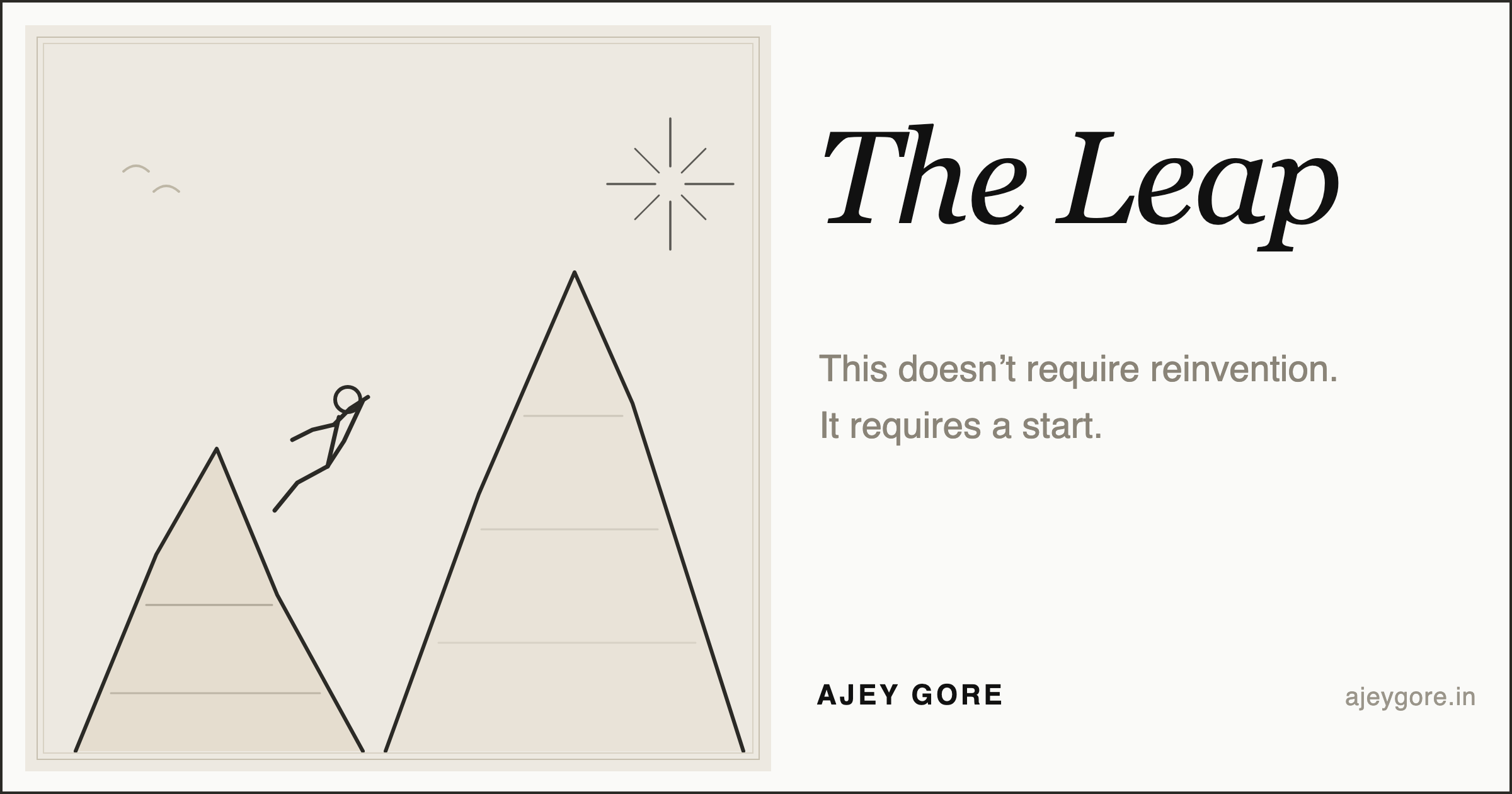
The peak on the other side is higher than the one you’re on. That is the entire reason to go. But nobody gets across by surveying it for three years from a standing start, and this is the shortest that gap will ever be. The archive is loaded, the systems are ready, and the only thing between your company and higher ground is somebody willing to push off.
Pick the friction. Everything else follows from there.
More to come.
References & further reading
- The Anatomy of an AI-Native Org — what the org chart looks like once the translation layer is gone.
- AI ate my role! What’s next? — the same collapse, read one role at a time.
- The Tests We Skipped — why defining correctness stopped being optional.
- The Solo Climb — what a load-bearing harness actually is, and why speed needs one.
- The Facade — how to tell a demo from a building before you fund the next phase.
Comments
via GitHub · no account? tweet at me