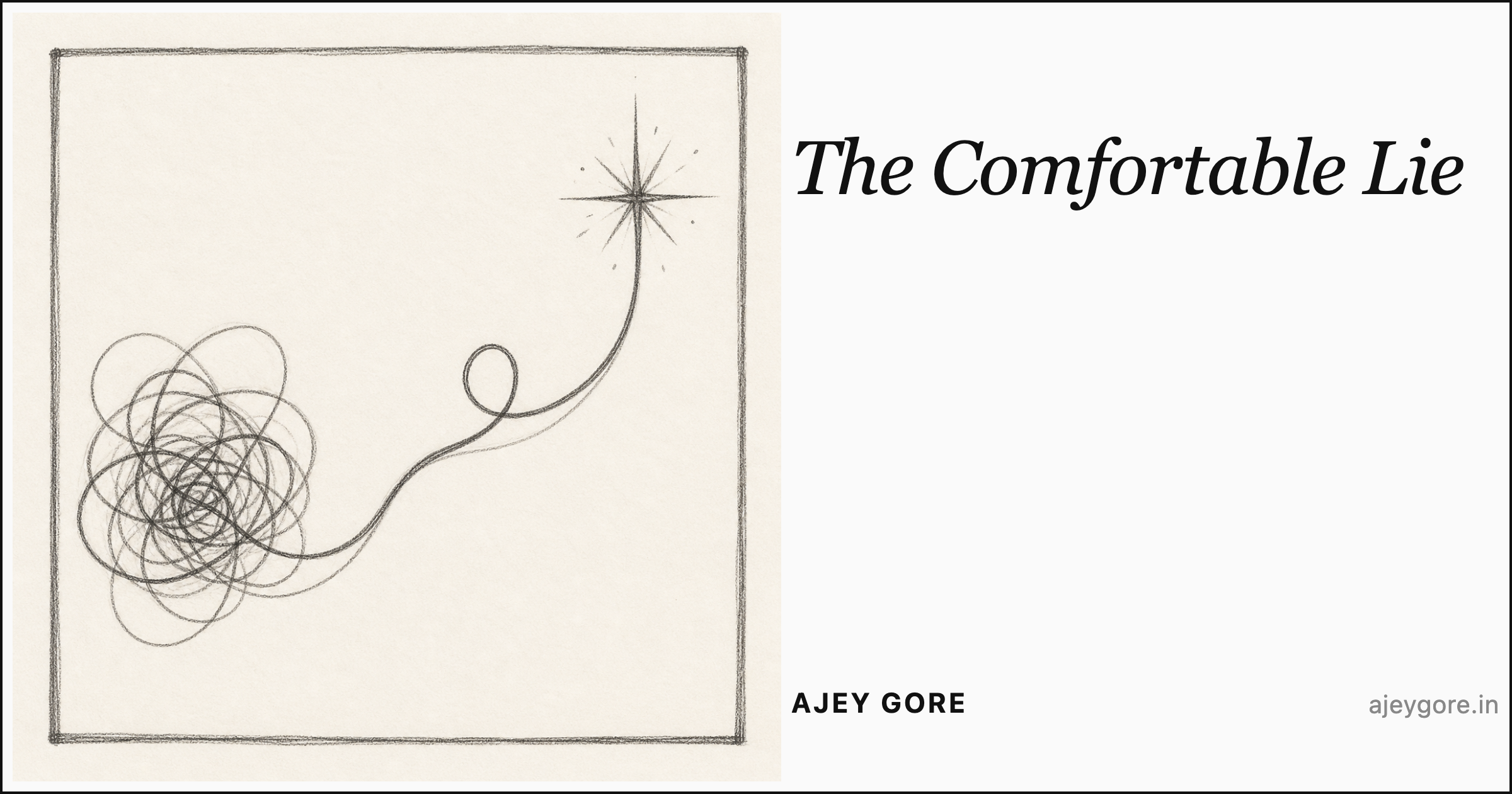
Three months ago I wrote The Space Between Chapters. That was about the decision to stop. This one is about what happened after.
Three months of notes
I’ve been advising founders, having long conversations with people I respect, and — mostly — paying attention to things I was too busy to notice when I was running in overdrive. Some of what I noticed was about them. Most of it, uncomfortably, was about me. Turns out when you’re constantly matching your potential and raising the bar, you build up a nice collection of stories about yourself that don’t hold up once you actually sit still and look at them.
These are six of those stories. I’m calling them comfortable lies because that’s what they are — things we tell ourselves that feel like ambition or discipline or strategy, but are really just habits we never bothered to examine. They’re comfortable because they sound right. They’re lies because they quietly do damage while we nod along.
Perfection is a spiral
Here’s what happens when you suddenly have time: you start perfecting things. That draft you never polished. That product idea you never fully fleshed out. That skill you always meant to sharpen. And because there’s no deadline forcing you to stop, you don’t stop.
I caught myself doing this within the first month. I’d work on something, get it to 90%, and then spend three times as long chasing the remaining 10%. Not because the 10% mattered — but because I could. Time was available, and perfection filled the vacuum.
I see this in founders too. The ones with runway and breathing room sometimes produce less than the ones with six months of cash and a fire under them. That always seemed paradoxical to me, but now I get it. When you have the luxury of perfection, perfection becomes the trap. It disguises itself as ambition. You think you’re being rigorous. You’re actually just avoiding the discomfort of shipping something that isn’t flawless.
“Done” is a decision you make. Perfection never makes it for you.
Stop matching your potential
People love overdrive. Especially the best ones.
You figure out what you’re good at, you hit that gear, and then you stay there. Every day. Every quarter. You keep matching your potential, and every time you match it, you move the bar higher. Match, raise, match, raise. It feels like growth. It looks like growth. Everyone around you thinks you’re killing it.
But here’s what’s actually happening — you’re chasing your own known potential so hard that you never stop to look sideways. You’re so locked into being as good as you know you can be that you have zero bandwidth left to discover what else you could be. The overdrive becomes the identity. And then you’re not even choosing it anymore, you’re just stuck in it.
I’ve seen this destroy people. Not dramatically — quietly. They burn out not because the work was too hard, but because they never gave themselves permission to operate at anything less than their known max. They kept upping the game, kept raising the bar, kept pushing — and one day they looked up and realised they were exhausted and hadn’t learned anything new in years. All that potential-matching had turned into a treadmill.
What if you deliberately lived a little below your known potential? Not laziness — slack. The kind of slack where you take that random side conversation. Where you notice a problem you wouldn’t have seen because your brain was already maxed out. Where some idea shows up uninvited because there’s actually room for it to land.
The ceiling you know about is not the only ceiling that exists. You just can’t see the other one while you’re pressed flat against this one.
Goals are byproducts
We’ve been taught to set big goals and reverse-engineer our way to them. Become healthy. Build a great company. Be a better parent.
The problem is, these aren’t goals — they’re identities. And identities are fragile. One bad week and “become healthy” feels like a failed project.
I’ve been experimenting with flipping this. Don’t make health the goal. Make exercising three times a week the thing you do. Eat sugar only on specific days. Stretch on alternate mornings. Eventually, health happens — not because you chased it, but because it was the byproduct of actions you actually controlled.
This changes how I think about strategy too. Strategic thinking doesn’t come from having a strategic goal. That sounds backwards, but stay with me. If you set “be strategic” as your north star, you end up paralysed by abstraction. But if you pick the right micro-actions — the daily, weekly, unglamorous inputs — the strategy emerges on its own. The byproduct is the strategy. The inputs are the work.
I keep telling founders this and watching their faces when it clicks. Stop measuring yourself against the identity. Start measuring yourself against the actions. Did you do the thing today? That’s the only question that matters.
Stopping lets you see
This one is personal.
When you’re in motion — shipping, advising, building, scaling — everything looks like progress because you’re moving. You develop this optimism bias that’s almost invisible from the inside. The product is getting better. The team is growing. The metrics are trending up. So what’s the problem?
The problem is that motion makes you blind to specific things. The thing that’s quietly breaking. The feedback you’ve been deflecting. The pattern you’re too busy to see because seeing it would mean stopping, and stopping feels like failure.
I watched this in myself at every stage of my career — ThoughtWorks, CodeIgnition, Gojek, PeakXV. I was always in motion. And in the three months since I stopped, I’ve seen things I couldn’t see while running. Not because I’m smarter now. Because I’m still.
The most important realisations I’ve had in three months came from weeks where I did almost nothing. Your receptors open when you stop. You start hearing what was always there. Not because nothing is productive — but because nothing got out of the way.
This is a cognitive revolution, not a job crisis
There’s a growing anxiety that tech jobs are going away. That AI is making people irrelevant. I talk to people every week who believe this, and I understand why they do — the pace of change is genuinely unsettling.
But I’ve seen this before. Not this exact thing, but the shape of it. The industrial revolution didn’t eliminate work — it created entirely new kinds of work that nobody could have named ten years before it happened. What’s happening now is the same pattern. It’s a cognitive paradigm shift, not a replacement event.
I wrote about this in The Expensive Thing — when execution becomes nearly free, judgment becomes the expensive thing. The work that requires context, taste, human connection, and the ability to define what “correct” means? That’s becoming more valuable, not less.
I see massive opportunity here. I see a need for people to recognise their own importance in this new era. Humans will be required more, not less — but the nature of what they’re required for is shifting. The tools got dramatically better. The need for people who know what to build with those tools got even greater. If you’re paying attention, this is one of the most exciting times to be building anything.
Patience is the thing I’m worst at
I’ll be honest about this one — I haven’t figured it out.
What to do is not the problem. There is so much to do. Ideas, projects, people to help, things to build, conversations to have. The problem is that seeing all of it at once creates its own anxiety. Not the anxiety of having nothing — the anxiety of having everything and not enough hours. It makes me less calm than I want to be.
I’m learning — slowly, badly — that I can’t execute everything on my own. That sentence is easy to write and brutal to actually live by. And on the other side of it, I’m also learning that I can’t delegate everything either. Some things need my hands on them. Some things genuinely don’t. Figuring out which is which turns out to be its own full-time job, and I’m not particularly good at it yet.
Patience isn’t waiting. That’s the wrong definition. Patience is choosing what to do next without panicking about everything you’re choosing not to do. Three months of space have at least made me aware that this is the real work — not the tasks, but the calm required to sequence them.
The comfortable lie
Three months is not a long time. But it’s long enough to see something clearly: we are extraordinary storytellers — especially to ourselves.
Every one of these six things was a narrative I’d been weaving for years. Perfection is rigour. Running at full potential is discipline. Big goals are strategy. Motion is progress. I believed all of it. It was comfortable to believe, because it sounded like ambition. It sounded like someone who had their act together.
That’s the comfortable lie. It’s not the things we tell others — it’s the story we construct for ourselves and then stop questioning. We repeat it so many times that it stops being a narrative and starts being the truth. And the longer you run, the harder it is to see it for what it is, because examining it would mean stopping, and stopping feels like losing.
But when you do stop — when you put everything out there and just observe — things start surfacing. The narrative loosens. You see the gap between the story and the reality. Reflection becomes easier, not because you’ve become wiser, but because you’ve finally become still enough to look.
I’m still looking. More to come.
Comments
via GitHub · no account? tweet at me